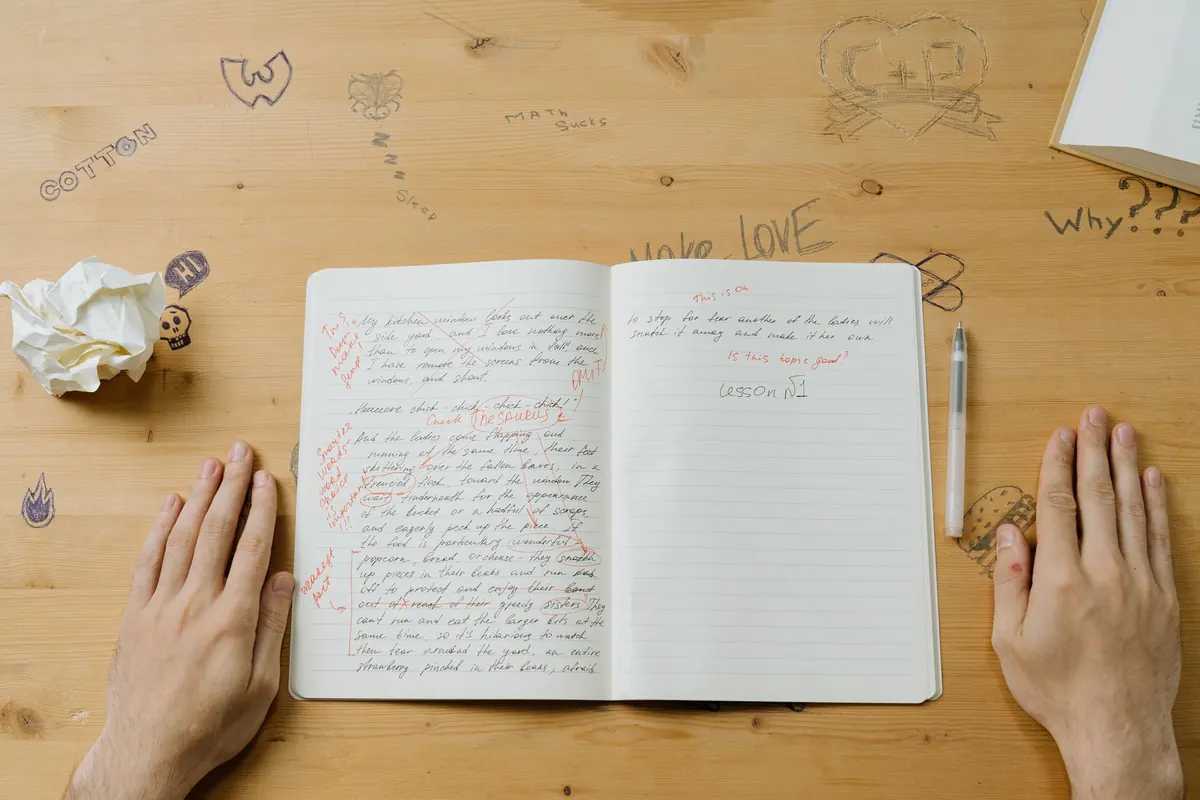


Starting a Writer's Notebook: A Beginner's Guide
How to choose a writer's notebook, divide it into useful sections, and turn a few minutes a day into a writing habit that lasts.

There is a particular pleasure in a new notebook: the crack of the spine, the first clean page, the sense that something worthwhile is about to be written down. That pleasure fades fast if the notebook has no job to do. A writer's notebook earns its keep when it has a purpose — a place to catch sentences, lists, overheard remarks, half-formed ideas and the small details you would otherwise have forgotten by Thursday.
Setting one up takes about twenty minutes. Keeping it going takes five minutes a day, at most. Here is how to choose the right book, divide it up in a way you will actually use, and turn the habit into something that sticks.
What a writer's notebook is for
It is not a diary. Diaries record what happened; a writer's notebook records what might be useful. It sits closer to a workshop bench than a ledger — a surface where raw material waits to be shaped.
That material can be anything:
- a phrase that arrived while you were walking to the shop
- a stranger's turn of speech on the bus
- the exact colour of a winter sky at four in the afternoon
- a question you cannot answer yet
- three lines of dialogue with no story attached
None of it needs to be good. Most of it will never be used. The point is to have it when you need it, rather than hoping your memory holds up.
Choosing the notebook
Notebooks are personal, but a few practical questions are worth settling before you hand over any money.
Size and shape
A notebook you leave at home is a notebook you will not use. A5 — roughly the size of a paperback — fits most bags and gives you room to write. A6 fits a coat pocket and suits short bursts. Anything larger tends to stay on a desk, which is fine if your desk is where you write. Decide where the notebook will live, then buy for that place.
Paper and ruling
If you write with a fountain pen, test the paper before committing to a brand; some thin papers feather or bleed badly. Gel and ballpoint pens are less fussy. As for ruling: lined helps if you want straight prose, dot grid is flexible enough for lists and sketches, and blank paper suits people who think in diagrams — and frustrates people who do not.
Binding
Look for a sewn binding if you plan to fill the book, or anything that lies flat when open. Cheap glued spines crack and shed pages. Elastic bands and ribbon markers are conveniences, not requirements. Buy something you like the look of, because you will see it every day, and buy it cheaply enough that you never feel guilty about crossing things out.
Setting up your sections
Some writers keep separate notebooks for separate purposes. Most do better with one book and a handful of sections, because a single notebook is always the right one to reach for.
Keep the number of sections small. Six is plenty:
- Capture. The main body of the book: whatever arrives.
- Lines and phrases. Sentences you like, including your own. Especially the ones you have not written yet.
- Details and observations. Sensory notes, small behaviours, weather, gestures. This section fills fastest.
- Reading notes. Passages worth remembering, always with the book and page number so you can find them again.
- Ideas. Projects, titles, structures, problems to solve later.
- Questions. Things you do not yet know. The most underrated section in the book.
You do not need to set aside fixed pages for each. The simplest workable system is chronological: write everything in order, then note the page number of anything important on a contents page at the front. Number your pages lightly in the top corner as you go — five minutes with a pen saves an hour of searching.
A twenty-minute setup
If you want to start today, do this:
- Write your name and the date you began on the inside cover.
- Number the first twenty pages in the top outer corner.
- On page one, draw a contents page and leave two pages for it.
- Give yourself a single line at the top of page three: Started today.
- Tape or clip a pen to the cover.
- Write one observation before you close the book.
That is the whole system. Everything else is maintenance.
Building the daily habit
Attach it to something you already do
New habits survive best when they hang off old ones. Coffee, the train, the walk back from school, the ten minutes before bed — pick one and put the notebook there. Same time, same place, every day.
Set the bar low
One line counts. One word counts, if it is the right word. A habit built on "I must fill a page" collapses inside a fortnight; a habit built on "I must write something" survives a bad week. Aim for five minutes, and let it run longer when it wants to.
Do not be precious about it
A notebook with no crossings-out is a notebook nobody is using properly. Leave the misspellings in. Keep the bad attempts. Date entries when you remember and skip the date when you forget. If you miss a day, write the next day and do not write an apology.
Read it back occasionally
Once a month, spend ten minutes flicking through what you have collected and circle anything that still interests you. This is where the notebook starts paying you back: patterns appear, and the note you scribbled in March becomes the paragraph you write in June.
Common sticking points
The blank page feels heavy. Start with something factual: the time, the weather, what you can hear. Description loosens the hand.
You have nothing to say. Write down what you noticed on the way home. Nobody is reading it.
You have started three notebooks and finished none. Choose the cheapest and carry it to the last page, even if you dislike it by the end. Finishing matters more than prettiness.
It has turned into a to-do list. Keep shopping lists on the back page. The front of the book is for writing.
Your first week
Day one, choose the notebook and set up the contents page. Days two to four, write one observation a day — nothing more ambitious. Day five, copy down a line you wish you had written, with its source. Day six, add a question you cannot answer. Day seven, read the week back and add one idea to the ideas section.
At the end of the week you will have seven entries and a working notebook, which is more than most people manage. From there it is simply a matter of keeping it within reach and saying something small in it every day.
Photo: Negative Space / Pexels